R&D Intensity Ranking in Semis: Who Keeps Doubling Down on the Future?
In semiconductors, research and development is not just a line item—it is the engine that determines who sets the pace of technology and who follows. R&D intensity, usually measured as R&D spending as a percentage of revenue, reveals how aggressively companies are investing in their future versus harvesting their present.

This article explores what R&D intensity means in the semiconductor context, how different types of companies approach it, why some players can sustain higher levels than others, and what this means for technology trajectories, competitive positioning, and career choices in the industry.
What “R&D intensity” really captures in semiconductors
R&D intensity is often expressed as a simple ratio: total R&D spending divided by total revenue. On the surface, it tells you how much of each dollar of sales is reinvested into future products, processes, and technologies. In semiconductors, however, the ratio captures several deeper realities.
First, it reflects the cost of staying on or near the leading edge. Pushing new process nodes, designing complex SoCs, and developing novel packaging or memory architectures requires enormous engineering effort, specialized tools, and long development cycles. Companies operating at the frontier must allocate substantial portions of their revenue to remain competitive.
Second, it indicates strategic posture. High R&D intensity typically signals a company that prioritizes growth through innovation—accepting lower near‑term margins to build future platforms. Lower intensity can imply a focus on mature, stable product lines where incremental improvements suffice, or simply more conservative strategy.
Third, it exposes structural constraints. Firms with volatile revenues, heavy debt, or thin margins may struggle to sustain high R&D ratios even if they wish to. Conversely, companies with strong cash generation and disciplined capital allocation can deliberately sustain elevated R&D intensity over many years.
Different profiles of R&D‑intensive semi companies

Not all semiconductor companies are trying to win in the same arena. R&D intensity patterns tend to reflect distinct strategic profiles, each with its own logic.
1. Leading‑edge logic and AI platform players. Companies focused on CPUs, GPUs, AI accelerators, and high‑performance networking silicon often display some of the highest R&D intensity. Their business models depend on delivering major architectural advances every few years, maintaining competitive performance per watt, and optimizing complex software‑hardware stacks. For these firms, deep investments in microarchitecture, compiler ecosystems, interconnect fabrics, and co‑design with customers are non‑negotiable.
2. Advanced foundries and process technology leaders. Dedicated foundries and IDMs that push top nodes—N3, N2, and beyond—invest heavily in process R&D, integration, and yield improvement. Their R&D intensity reflects not only research into transistor structures and materials, but also massive engineering effort to translate lab breakthroughs into manufacturable, high‑yield production flows. Even small changes in line edge roughness, defect density, or interconnect reliability can demand large teams and long experiments.
3. Memory and storage innovators. DRAM, NAND, and emerging memory players must continually evolve cell structures, stacking architectures, controllers, and signal processing techniques. Their R&D intensity often stays high because performance, endurance, and cost per bit hinge on repeated cycles of innovation—especially for technologies like HBM, high‑layer NAND, and specialized enterprise DRAM mixes.
4. Equipment and materials suppliers. Tool and materials firms operate upstream, but their businesses are profoundly R&D‑driven. Developing next‑generation lithography subsystems, etch and deposition tools, metrology solutions, photoresists, and specialty gases demands sustained investment. Their R&D intensity reflects the need to stay ahead of customers’ roadmaps and co‑develop solutions for new nodes and packaging schemes.
5. Niche analog, power, and sensor specialists. Companies focusing on analog, power electronics, RF, or sensors may have moderate but highly focused R&D intensity. They invest deeply in application‑specific expertise—automotive safety, industrial robustness, RF front‑ends—even if their overall R&D percentage is lower than leading‑edge logic players. In these segments, domain knowledge and reliability engineering can matter as much as raw transistor scaling.
Why some companies can “double down” while others can’t
Maintaining high R&D intensity is not simply a matter of choice; it depends on structural factors that vary widely across firms.
Revenue scale and stability. Large, diversified companies with stable demand and strong margins have more room to allocate sizable R&D budgets without jeopardizing financial health. Smaller firms or those tied to volatile end markets may struggle to commit the same percentage of revenue, especially in downturns.
Product mix and margin profile. Businesses with high gross margins—often in advanced logic, specialized equipment, or high‑end memory—can fund extensive R&D. Commodity or price‑pressured segments may find it harder to sustain such investments, leading to more incremental innovation and lower intensity.
Capital structure and investor expectations. Companies with conservative balance sheets and long‑term‑oriented investors may be encouraged to keep R&D spending high. Others face pressure for near‑term earnings, making it difficult to maintain elevated R&D ratios when cycles weaken.
Strategic positioning. Some firms deliberately choose to be fast followers or focus on mature nodes, accepting lower R&D intensity as part of their identity. For these players, the goal is efficient execution and cost competitiveness, not pushing the frontier.
Lifecycle stage. Younger, growth‑stage companies often exhibit very high R&D intensity because they are still building their core technologies and product portfolios. Mature firms may show lower ratios but still invest heavily in absolute terms due to larger revenue bases.
How high R&D intensity shapes technology trajectories
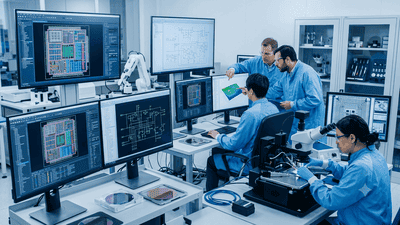
R&D intensity is more than a financial metric—it shapes how quickly and in what directions the industry evolves.
Acceleration of node transitions. Process‑heavy companies with strong R&D budgets can move more quickly from one node generation to the next, compressing the time between major technology inflections. This affects not only their own products but also the expectations of fabless customers and equipment vendors.
Depth of system‑level innovation. Firms that invest heavily in both silicon and software can drive system‑level advances: tighter integration of accelerators and memory, domain‑specific architectures, and optimized interconnect topologies. These innovations ripple across data centers, vehicles, and industrial systems.
Breadth of product platforms. High R&D intensity allows companies to maintain multiple product families simultaneously—CPUs, GPUs, networking chips, custom accelerators—each with rich roadmaps. This breadth gives them more ways to participate in emerging markets and to offer platform solutions to customers.
Experimentation with emerging technologies. Firms with surplus R&D capacity can explore emerging directions—new memory types, neuromorphic computing, photonic interconnects, heterogeneous integration—even if commercial payoff is uncertain. This exploration seeds future disruptions.
In contrast, companies with limited R&D intensity may focus on incremental improvements and cost optimization, contributing to stability but less to dramatic shifts in industry architecture.
Risks and downsides of very high R&D intensity
Doubling down on the future comes with risks. Extremely high R&D intensity is not automatically beneficial if it is poorly directed or misaligned with market realities.
Execution risk. Large R&D programs can fail to deliver usable products on time or at acceptable yields. The more ambitious the roadmap, the higher the potential for delays, re‑spins, or costly course corrections.
Over‑investment in the wrong bets. Companies can allocate significant R&D resources to technologies or standards that do not gain traction. This risk is especially acute in fast‑moving areas like AI architectures or novel memory, where multiple competing paths exist.
Margin pressure. Sustaining high R&D intensity without commensurate revenue growth can compress margins and strain cash flows. Firms must balance long‑term innovation with near‑term financial health.
Organizational complexity. Large R&D organizations can become unwieldy, with overlapping teams, internal competition, or communication gaps between research and product groups. Managing complexity is a challenge in itself.
Consequently, the most successful high‑intensity companies combine deep investment with disciplined portfolio management, ruthless prioritization, and clear linkage between R&D programs and strategic outcomes.
Signals that a company is truly “doubling down”

Beyond financial reports, several qualitative signals indicate that a semiconductor company is genuinely doubling down on the future.
Consistent roadmap execution. Firms that reliably deliver new generations of products—nodes, architectures, packaging schemes—on roughly planned timelines, even through cycles, show commitment to sustained innovation.
Transparent long‑term technology plans. Detailed public or customer‑facing roadmaps for nodes, performance targets, and integration strategies signal that R&D is not ad‑hoc but guided by coherent vision.
Investment in foundational research. Support for pre‑commercial research—work with universities, labs, and internal exploratory teams—demonstrates a willingness to seed future breakthroughs beyond immediate product needs.
Talent density in engineering. High ratios of experienced engineers and technical leaders, along with strong internal cultures around design reviews, experimentation, and learning, reflect that R&D is central to the company’s identity.
Resilience across cycles. Companies that sustain core R&D programs even during downturns, rather than slashing innovation to protect short‑term earnings, show genuine long‑term discipline.
Implications for careers and ecosystems
R&D intensity also shapes the environment for engineers, researchers, and ecosystem partners.
Career paths. Working at a high‑intensity firm often means exposure to cutting‑edge projects, complex challenges, and frequent platform updates. It can be demanding but offers rich learning and strong career signaling. Lower‑intensity environments may provide more stability and depth in specific mature domains.
Startup and partner opportunities. Companies that invest heavily in R&D create fertile ground for startups and partners—IP blocks, EDA tools, materials innovations, packaging technologies—that can integrate into their roadmaps. High R&D intensity can thus support vibrant ecosystems around core platforms.
Regional technology clusters. Regions that host multiple R&D‑intensive semi firms often develop strong technology clusters: talent pools, academic collaborations, and supporting industries. These clusters reinforce each company’s ability to sustain high R&D levels.
Educational priorities. High demand for advanced skills—architecture, verification, process integration, packaging science—encourages universities and training programs to align curricula with industry needs, shaping the next generation of engineers.
Balancing present returns and future bets
Ultimately, R&D intensity ranking in semis is about how each company balances present returns with future bets. Those who keep doubling down on the future accept that innovation is costly and uncertain, but necessary to remain relevant as AI, advanced nodes, and new system architectures reshape the landscape.
For investors, customers, and employees, understanding a firm’s R&D posture means looking beyond absolute spending to the coherence of its technology strategy, the discipline of its portfolio, and the consistency of its commitment across cycles. In a sector where yesterday’s breakthroughs quickly become today’s table stakes, the companies that maintain thoughtful, sustained R&D intensity are the ones most likely to define what comes next in semiconductors—and to turn that future into durable competitive advantage.